
Catalent Indiana LLC FDA 483: 8 Observations at Bloomington, Indiana and the Aseptic/Sterile Manufacturing Pattern Every Sterile Injectable Quality Leader Should Assess
FDA investigators closed an 11-day inspection of Catalent Indiana LLC's sterile injectable facility in Bloomington, Indiana, on April 24, 2026, documenting eight inspectional observations spanning environmental monitoring, aseptic process validation,…
On this pageArticle overview
FDA investigators closed an 11-day inspection of Catalent Indiana LLC’s sterile injectable facility in Bloomington, Indiana, on April 24, 2026, documenting eight inspectional observations spanning environmental monitoring, aseptic process validation, visual inspection, and investigation practices. The Form 483, issued to Lars Arnoldsen, Corporate Vice President and General Manager, by Detroit District Office investigators Joohi Castelvetere, Robert J. Ham, and Brandy N. LePage, is not a determination that Catalent’s products are adulterated or that any regulation has been violated — it is a record of conditions the investigators observed. This article analyzes the 483 and the regulatory escalation pattern it represents — not Catalent’s written response, which is a matter between the firm and the agency. What makes this 483 significant is context: the same Bloomington site, operating since December 2024 under Novo Holdings ownership following the $16.5 billion Novo Nordisk manufacturing-network acquisition, is already the subject of an active Warning Letter (320-26-20, issued November 20, 2025) for the same underlying issue this 483 documents as continuing — extrinsic mammalian hair particulates identified in finished sterile drug product.
The Ongoing Contamination Pattern: Why the Aggregate Investigation Is Failing to Close Individual Batch Deviations
Read closely, this 483 is less about a single contamination event and more about whether the site’s investigation and corrective action infrastructure can actually close a known problem. Observation 1A states that mammalian hair has been identified in finished units from approximately August 30, 2025 to present, including three occurrences in 2026, and that the probable root cause — stopper components — rests on an aggregated trend investigation, tracked under internal deviation record REC 1093464, that was opened August 28, 2025 and, as of the inspection, remained open and had not been substantiated through complete, batch-specific investigations as expected under 21 CFR 211.192. When a firm cannot close individual batch investigations because they are waiting on a system-level trend study that has itself been open for eight months, FDA reads that as evidence the quality system — not just the manufacturing line — is the actual gap. The same pattern repeats in observation 1B, where three separate media fill lots were cancelled or aborted due to water intrusion from roof leaks between January and March 2026, following approximately seven prior roof-related maintenance work orders in 2025, without the firm completing corrective action or evaluating the impact on commercial batches before resuming production in the affected areas.
Aseptic Process Validation, Environmental Monitoring, and Investigation Timeliness Gaps
FDA’s 2004 Guidance for Industry on Sterile Drug Products Produced by Aseptic Processing sets the expectation that a firm’s environmental monitoring and investigation program will identify adverse trends before they reach finished product, and that when contamination is confirmed in a released batch, the root-cause investigation must be batch-specific, timely, and capable of ruling out alternative causes — not simply attributed to a suspected component based on an ongoing aggregate study. Observation 3 in this 483 cites gaps in that direction under 21 CFR 211.113(b): airflow studies that do not adequately demonstrate first-air integrity under high-, moderate-, and low-risk interventions, and media fills (covering the period June through December 2025) that were not designed to represent worst-case interventions, line locations, vial sizes, and open-vial stress conditions. A media fill that has not simulated the actual challenge conditions of routine production cannot be relied upon as evidence that the aseptic process reliably excludes contamination.
The 483 also cites environmental monitoring deficiencies under 21 CFR 211.42, noting that monitoring was not always performed in response to interventions located at or impacting critical Grade A/ISO 5 surfaces, and under 21 CFR 211.22(d) that comprehensive trending analysis — including intra- and inter-location spatial analysis of the environmental monitoring and bio-decontamination programs — was lacking. In a mature Grade A/ISO 5 aseptic operation, every documented intervention should trigger a defined environmental monitoring response, and that data should be trended spatially across locations and time so that a cluster of exceedances, or, as observation 1G notes, a bio-decontamination requalification failure later attributed to a “rogue lot” of biological indicators, is caught before it becomes a pattern spanning multiple quarters.
Escalation Risk and the 15-Business-Day Response: What FDA Actually Needs to See
This is the profile FDA treats as high escalation risk. A repeat contamination signal at a site already carrying an active Warning Letter for the identical root cause, combined with 368 deviations and 147 complaints still open at the time of inspection, combined with visual-inspection defect classification practices in observations 1C and 1D that routed roughly 84 batches of particulate findings into only 27 investigations, is the kind of fact pattern that has historically preceded either a follow-up inspection focused narrowly on corrective action effectiveness verification or further formal correspondence from CDER. Sites that have already received a Warning Letter and then draw a subsequent 483 documenting the same unresolved condition are, in FDA’s own escalation logic, past the point where a written response alone is likely to close the matter — investigators typically expect to see the corrective action implemented and verified, not merely committed to, before the next inspection.
The firm had 15 business days to respond in writing — a window that, depending on the quality of the response, determines whether the matter closes, advances to further FDA correspondence, or triggers a follow-up inspection. What that response needed to demonstrate — and what FDA evaluators would have been looking for — was not simply an updated corrective and preventive action (CAPA) plan but closed, batch-specific investigations that no longer depend on an open aggregate trend study; documented interim controls that were actually in place during the roof-leak period, rather than a repair completed only after three aborted media fills; a revised defect classification procedure with objective criteria for when a critical finding triggers additional 100% reinspection; and quantitative evidence that the environmental monitoring and bio-decontamination trending programs now capture spatial and temporal patterns rather than treating each event in isolation.
For quality and manufacturing leaders at other sterile injectable sites, the transferable lesson is not about Catalent specifically — it is about the difference between a corrective action that closes a deviation record and one that closes the underlying risk. Sites carrying open aggregate investigations, environmental monitoring programs without spatial trending, or media fill designs that predate current production realities should assess those gaps now, before an inspection surfaces them. XGene Consulting supports sterile manufacturers through root-cause investigation design, CAPA effectiveness verification, Stage 2/3 process validation remediation, and mock-inspection readiness programs built specifically around 483 and Warning Letter response requirements. If your site is managing an open aseptic-process observation or preparing for reinspection, that is exactly the work we do.
XGene Aseptic Process 483 Remediation Framework
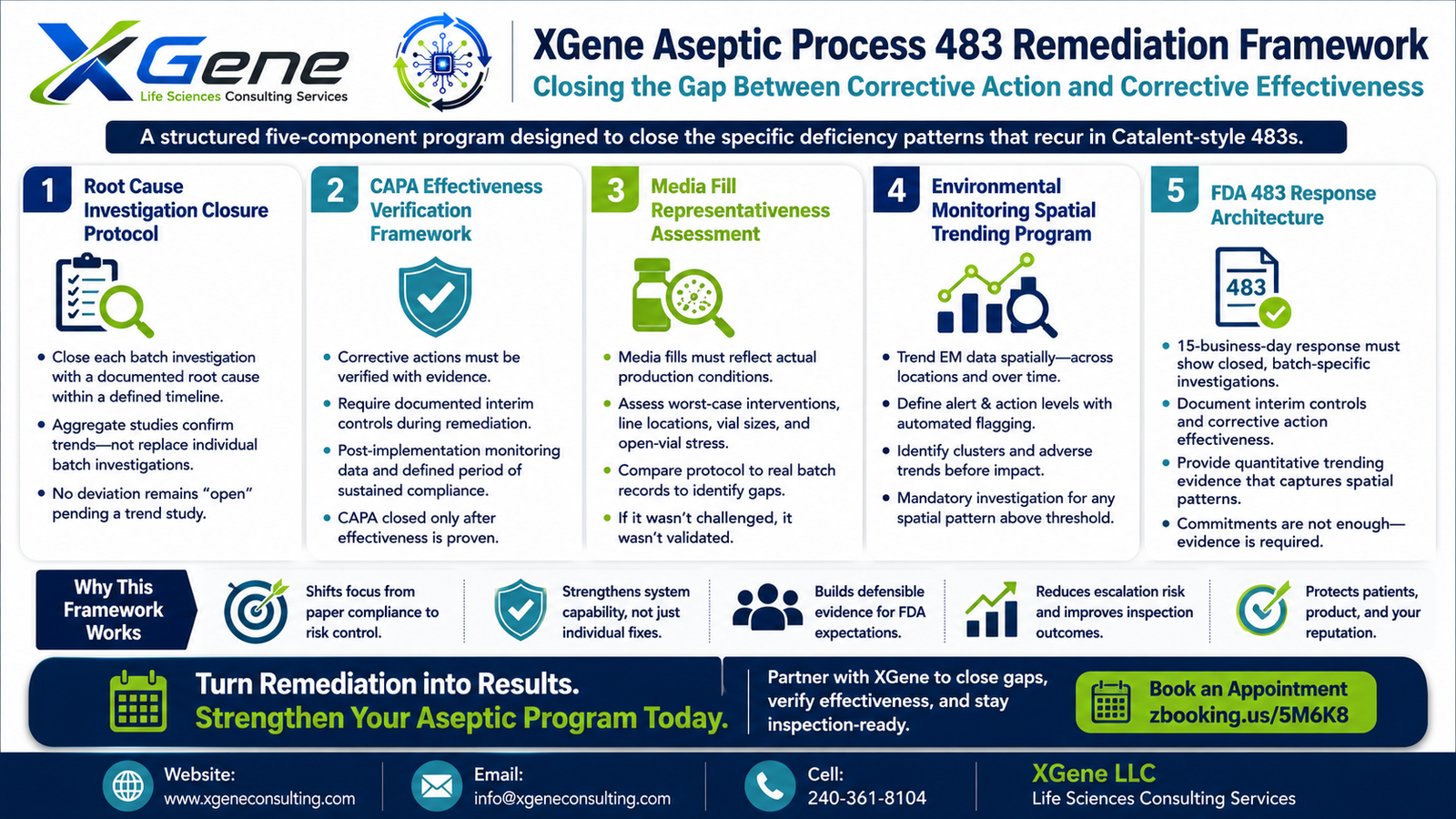
Closing the Gap Between Corrective Action and Corrective Effectiveness
The XGene Aseptic Process 483 Remediation Framework is a structured five-component program designed to close the specific deficiency patterns that recur in Catalent-style 483s — where aggregate investigations remain open for months, individual batch deviations are parked rather than closed, and media fill designs do not reflect current production reality.
1. Root Cause Investigation Closure Protocol: Individual batch investigations cannot remain open pending the completion of a system-level aggregate study. The protocol requires that each deviation be investigated to a closed, documented root cause within a defined timeline — and that the aggregate study serves as a confirmatory trending mechanism, not the primary investigation vehicle.
2. CAPA Effectiveness Verification Framework: Corrective actions must be verified with evidence, not just committed to. The framework requires documented interim controls during the remediation period, post-implementation monitoring data, and a defined period of sustained compliance before the CAPA is considered closed.
3. Media Fill Representativeness Assessment: Media fill designs must reflect actual production conditions — including worst-case interventions, line configurations, vial sizes, and open-vial stress conditions. The assessment compares the media fill protocol to actual batch records over a defined period to identify gaps in representativeness.
4. Environmental Monitoring Spatial Trending Program: EM data must be trended spatially — not just chronologically. The program establishes intra- and inter-location trending with defined alert and action levels, automated flagging for spatial clusters, and mandatory investigation for any spatial pattern exceeding the defined threshold.
5. FDA 483 Response Architecture: The 15-business-day response must demonstrate closed, batch-specific investigations, documented interim controls, and a trending program that captures spatial patterns — not a revised CAPA plan. The framework provides a structured response template mapped to each 483 observation.