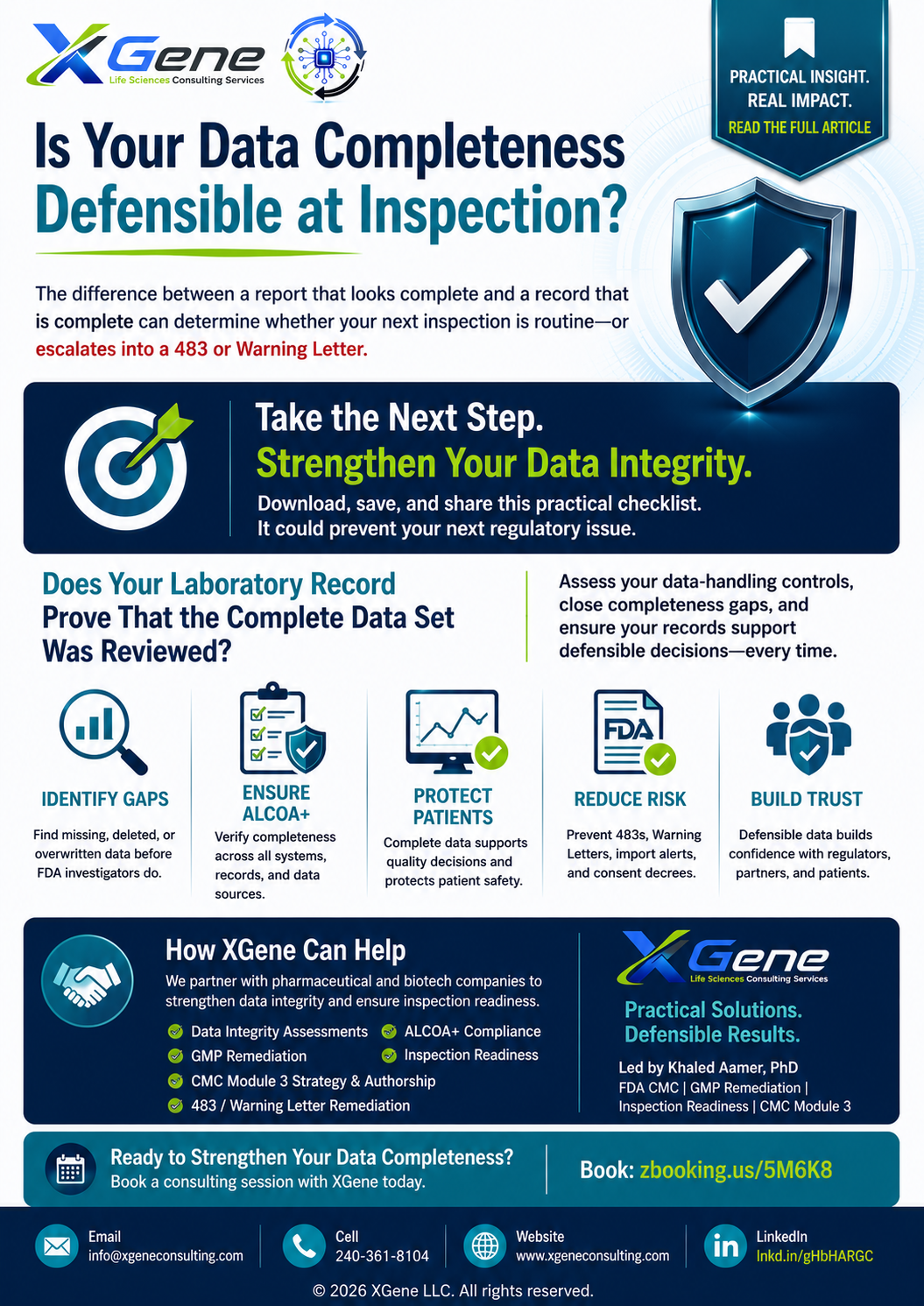

FDA investigators are trained to look for what is missing from your data records before they look at what is present — and the deletion of failed runs, rejected results, or inconvenient data points is the data integrity violation that most reliably transforms a 483 observation into a Warning Letter.
That sentence reflects one of the most consistent and consequential patterns in FDA data integrity enforcement over the past decade, and it points directly to the structural vulnerability that most pharmaceutical laboratories carry into every inspection cycle without recognizing it: GMP data systems that are technically compliant in their record-keeping architecture but operationally incomplete in their data retention practice. The audit trail captures what was entered. It does not always capture what was deleted, why it was deleted, or whether the deletion was scientifically justified and management-authorized.

Section 1 — What Completeness Requires: The Full Data Set Principle in FDA Enforcement Positions
The ALCOA+ principle of completeness is deceptively simple in its statement and deeply demanding in its operational application. Completeness requires that all data generated in the conduct of a GMP activity is retained and available for review — not only the data that supports the desired conclusion. The regulatory basis sits across multiple provisions: under 21 CFR 211.192(a), all laboratory records — including those for tests that fail specifications — must be retained, reviewed, and, where failures are noted, investigated for cause. Under 21 CFR 211.180, records must be retained for the period specified in the regulation, and destruction of records before the applicable retention period constitutes a separate and independent violation. Under 21 CFR 211.68(b), automatic, mechanical, and electronic equipment used in the generation and management of GMP records must produce records that are accurate and complete.
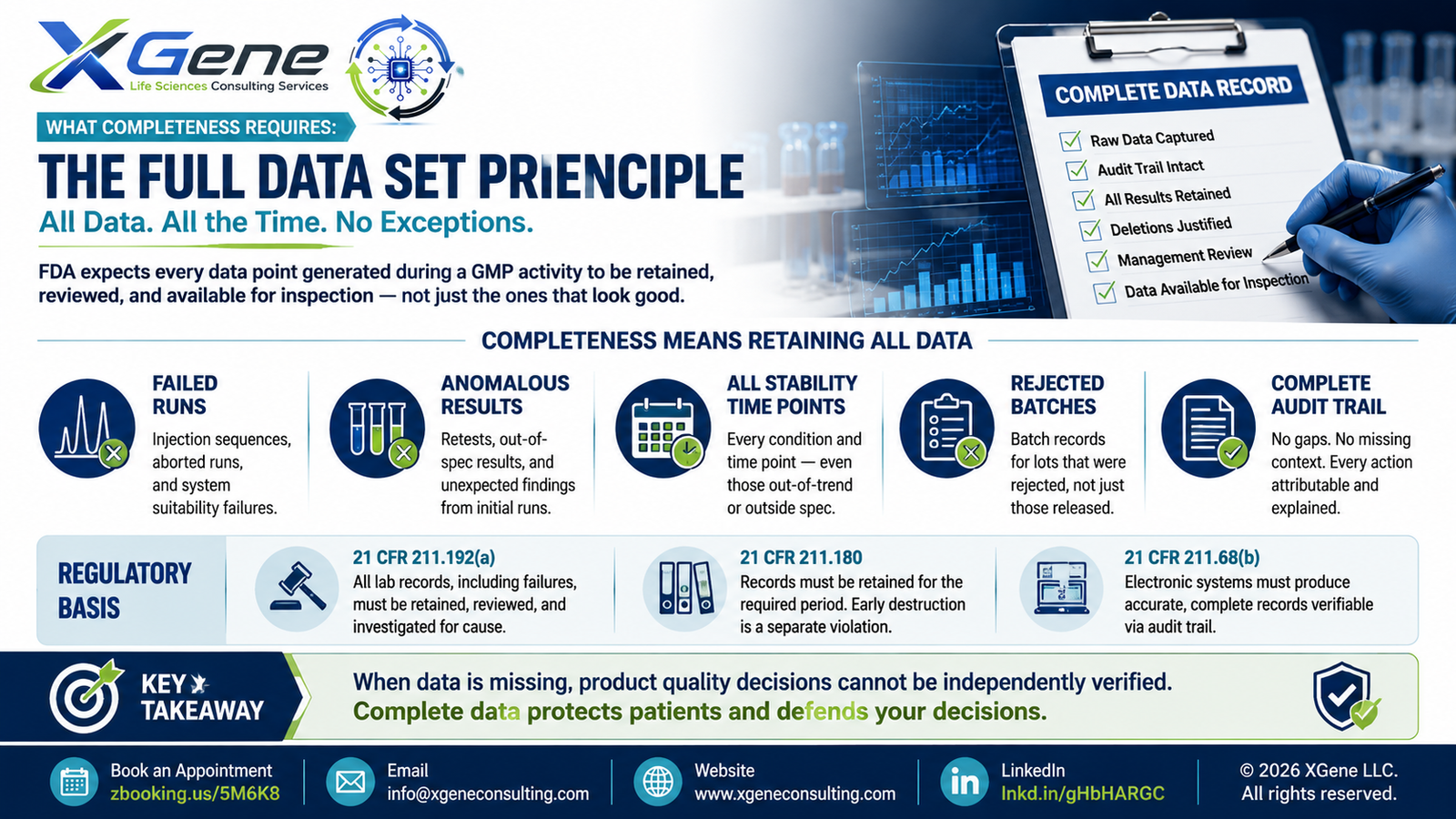
The HPLC injection sequence is the most consistent and technically specific tool FDA investigators use to identify completeness gaps in the pharmaceutical laboratory. When an FDA investigator sits down with a laboratory chromatography data system, one of the first queries they run is a sequence file completeness review: they compare the injection numbers assigned to every run executed on the system against the results reported in the batch records and analytical worksheets. Missing injection numbers — numbers that exist in the sequence file but are absent from the corresponding results report, with no documented explanation in the audit trail — are flagged immediately as a completeness gap.
Section 2 — How Deletion, Overwrite, and Test-Until-You-Pass Become Data Integrity Findings
The technical mechanism by which deletion, overwrite, and selective retention become FDA findings is the audit trail. Every GMP-compliant electronic system is required, under 21 CFR 211.68(b) and 21 CFR Part 11, to maintain a secure, computer-generated, time-stamped audit trail that records the date and time of operator entries and actions that create, modify, or delete electronic records. A laboratory in which the audit trail is technically enabled but operationally unreviewed is a laboratory in which deletion can accumulate without detection until an FDA investigator conducts the review that internal quality systems failed to perform.
Stability data completeness is the dimension of this problem with the most direct regulatory submission consequence. When FDA inspectors compare the data in an approved application against the data in the sponsor’s stability data system and find time points that are in the system but not in the submission, the finding is not limited to a 21 CFR 211.192 observation — it becomes a question of whether the approved shelf life is supported by the complete data set.
Section 3 — The Metadata Layer: What FDA Investigators Extract from Instrument Data Files
The metadata embedded in electronic instrument data files is the technical foundation of FDA’s data completeness investigation capability in the modern inspection environment. When an FDA investigator accesses a chromatography data system during an inspection, they are interrogating the underlying electronic records for the metadata layer that the printed report does not contain: file creation timestamps, user login identity, injection sequence numbers, and processing parameters applied at the time each result was calculated.
The XGene Data Completeness Assurance and Audit Program
Eliminating the Deletion Problem Before FDA Arrives
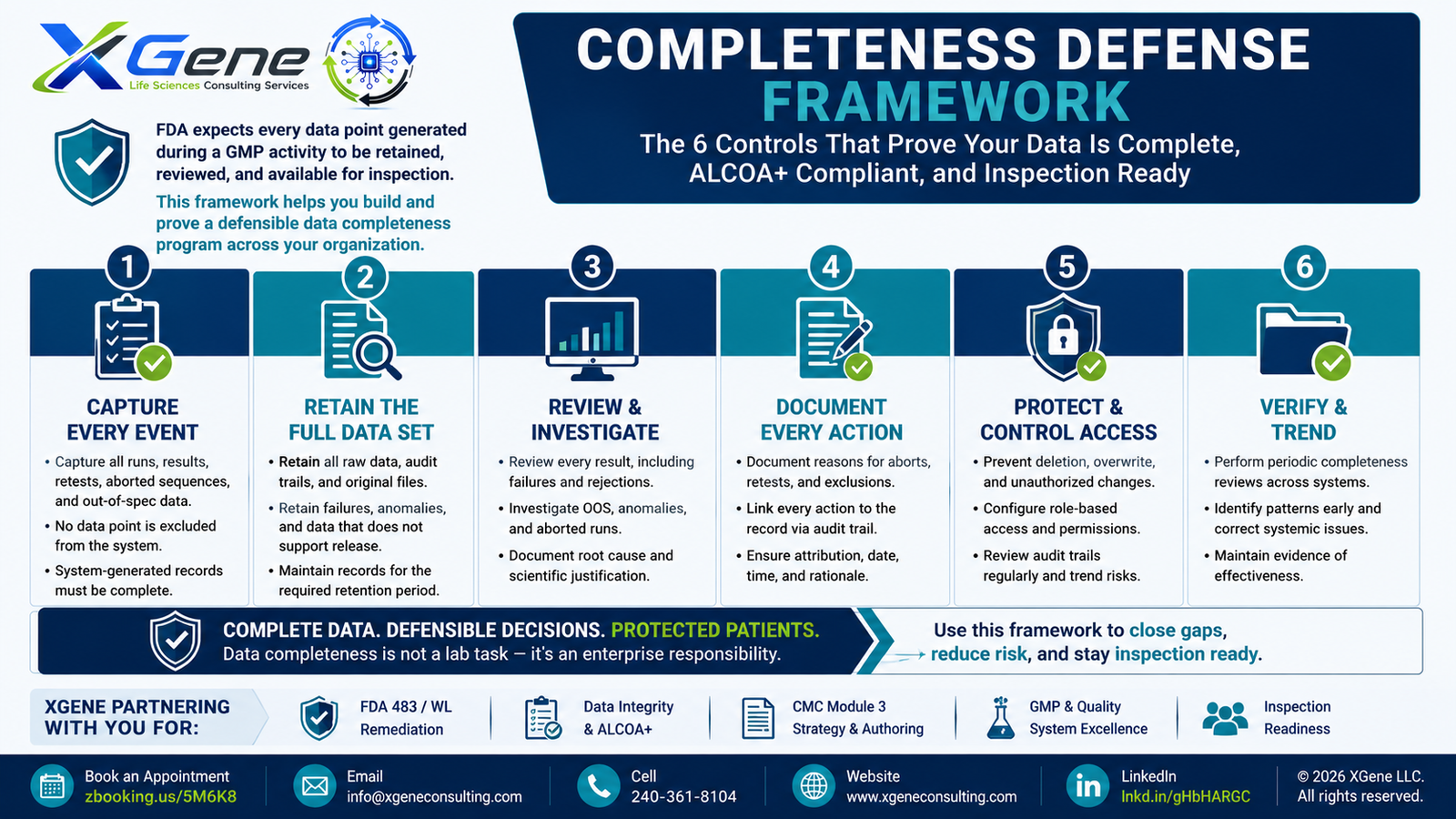
A structured completeness verification program built against the specific completeness gap patterns FDA investigators document under 21 CFR 211.192(a), 21 CFR 211.68(b), and 21 CFR 211.180. The program operates across five integrated workstreams:
Workstream 1 — Audit Trail Completeness Verification: periodic, QA-independent review confirming every GMP electronic system’s audit trail is active, attributable, and free of unexplained gaps between printed reports and the electronic archive.
Workstream 2 — Injection Sequence Completeness Review: systematic, non-inspection-triggered review of every chromatographic system’s injection sequence against batch records, producing a documented completeness certification for each system and period.
Workstream 3 — Aborted Run Documentation and Stability Completeness Audit: defined documentation requirements for every started-and-stopped run, plus an annual audit confirming every stability protocol time point is tested, documented, and reported.
Workstream 4 — Development Data Completeness Review for CMC Submissions: every analytical data table in a Module 3 submission traced to its source records, with data migration events verified for source-to-destination completeness.
Workstream 5 — QA Release Process with Systematic Completeness Check: a defined completeness verification step built into batch disposition, documented in the batch record as a distinct, contemporaneous QA action.
The thesis that runs through every data completeness Warning Letter is the one stated at the outset: selective retention of passing results and deletion of failing results produces a data record that appears compliant while the product it describes may not be. Data completeness is not a documentation requirement that exists to satisfy an administrative preference for complete files — it is the foundational assurance mechanism that makes every other element of the GMP quality system meaningful. The facilities that survive FDA’s inspection methodology are the ones that have built their internal data management programs around the same systematic completeness discipline before the investigator arrives.
Select any five HPLC sequence files from your GMP laboratory from the past 90 days and verify that every injection number is accounted for in the corresponding results report. If any injection number is missing without a documented explanation in the audit trail, you have an ALCOA+ completeness gap.
XGene Consulting’s Data Completeness Assurance and Audit Program identifies and closes these gaps before an inspection does.